Understanding Luxury Watches: What Makes Them Valuable and Unique
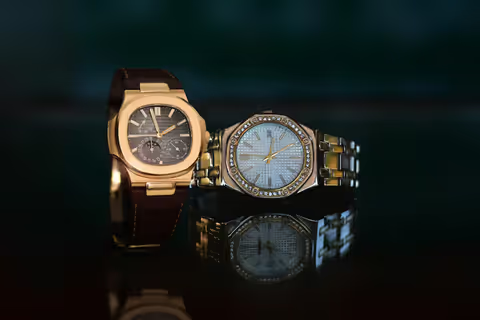
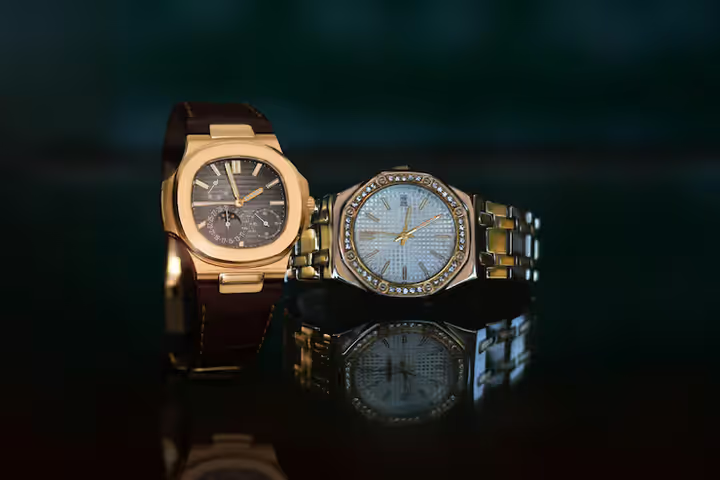
Luxury watches are timekeeping instruments created with a focus on precision, craftsmanship, materials, and long-term reliability. Unlike everyday watches designed mainly for basic time display, luxury watches exist to combine mechanical engineering, design heritage, and durability in a single object.
Historically, watches developed as practical tools for navigation, science, and daily life. Over time, certain watchmakers began refining movements, experimenting with materials, and emphasizing accuracy. This gradual improvement led to watches that were not only functional but also technically complex and visually refined.
Today, luxury watches represent the upper segment of watchmaking. They are often produced in limited quantities, assembled by skilled professionals, and designed to last for decades when properly maintained. Their value comes from how they are made, not from short-term trends.
Importance: Why Luxury Watches Matter Today
Luxury watches continue to matter in modern society despite the widespread use of smartphones and digital devices. Their relevance lies in several practical and cultural factors.
They affect:
-
Collectors seeking long-term value stability
-
Professionals interested in engineering and craftsmanship
-
Individuals studying design history and mechanical innovation
-
Markets related to certified timepieces and horology education
Key problems they address include:
-
Preservation of mechanical engineering skills
-
Demand for durable, repairable products
-
Interest in precision instruments that do not rely on frequent software updates
In an age of fast production and disposable goods, luxury watches highlight the importance of longevity, precision manufacturing, and quality control. They also play a role in education, particularly in mechanical design, micro-engineering, and material science.
Recent Updates: Trends and Developments (2024–2025)
Over the past year, the luxury watch sector has shown notable changes driven by technology, transparency, and sustainability.
Key developments observed since early 2024 include:
-
Increased use of recycled metals in watch cases
-
Greater emphasis on certified movements and traceable components
-
Rising interest in independent watchmakers
-
Growth of digital verification tools for authenticity
According to industry reports released in mid-2024, there has been a measurable increase in demand for mechanical watches with simplified designs and longer service intervals. In late 2024, several manufacturers also introduced movement upgrades focused on improved power reserve and shock resistance.
Another notable trend in 2025 is the integration of blockchain-based certification systems to document production history and ownership changes. This improves transparency and reduces documentation disputes.
Laws and Policies: Regulatory Influence on Luxury Watches
Luxury watches are affected by multiple regulations depending on the country of production and distribution. These rules focus on consumer protection, material sourcing, and product labeling.
Common regulatory areas include:
-
Hallmarking laws for precious metals
-
Country-of-origin labeling requirements
-
Environmental compliance for manufacturing waste
-
Export and customs classification standards
In many regions, watches containing gold or platinum must meet strict purity standards verified by government-approved assay offices. Additionally, international trade rules require accurate disclosure of manufacturing origin, especially when components are sourced globally.
Recent policy updates in 2024 strengthened environmental reporting standards for manufacturers using rare metals, ensuring responsible sourcing and reduced environmental impact.
Tools and Resources: Helpful References for Understanding Luxury Watches
Several tools and educational resources help individuals better understand luxury watches and their technical features.
Commonly used resources include:
-
Watch movement reference databases
-
Power reserve comparison charts
-
Timekeeping accuracy standards documentation
-
Serial number verification platforms
-
Educational horology websites
Examples of useful tools in table format:
| Tool Type | Purpose | Practical Use |
|---|---|---|
| Movement Database | Explains calibers and mechanisms | Learning technical differences |
| Accuracy Standards | Defines precision benchmarks | Comparing performance |
| Material Guides | Details metals and alloys | Understanding durability |
| Authentication Records | Tracks production details | Verifying originality |
These resources are widely used for research, education, and documentation rather than commercial activity.
Common Characteristics That Define Value
Several measurable and observable factors contribute to the value of luxury watches.
Key characteristics include:
-
Mechanical movement complexity
-
Finishing quality of internal components
-
Durability of case and crystal materials
-
Long-term serviceability
-
Historical consistency of design
Below is a simplified comparison table:
| Feature | Standard Watches | Luxury Watches |
|---|---|---|
| Movement Type | Quartz or basic mechanical | Advanced mechanical |
| Assembly | Automated | Hand-assembled |
| Lifespan | Short to medium | Long-term |
| Repairability | Limited | High |
These factors help explain why luxury watches are studied as technical instruments rather than everyday accessories.
Frequently Asked Questions
Are luxury watches accurate compared to digital timekeeping?
Luxury mechanical watches prioritize consistency and engineering precision. While digital devices may show higher raw accuracy, mechanical watches maintain reliable performance without electronic dependence.
Do luxury watches require regular maintenance?
Yes. Mechanical watches benefit from periodic servicing to maintain lubrication, accuracy, and component integrity over time.
What materials are commonly used in luxury watches?
They often use stainless steel, gold alloys, sapphire crystal, and advanced composites designed for durability and stability.
How are luxury watches tested for quality?
They undergo multiple inspections, including accuracy testing, water resistance evaluation, and durability checks under controlled conditions.
Why are production numbers often limited?
Limited production helps maintain quality standards, allows careful assembly, and supports long-term repair capability.
Conclusion
Luxury watches remain relevant because they combine engineering, durability, and historical continuity. Their value is rooted in how they are constructed, maintained, and regulated rather than in short-term demand cycles.
In recent years, improvements in transparency, sustainability, and technical refinement have strengthened their position as precision instruments. Regulatory frameworks and educational tools further support informed understanding.
For those interested in mechanical design, long-lasting products, and measurable craftsmanship, luxury watches offer a clear example of how traditional engineering continues to evolve in a modern context.